


Laid-off workers rallied in the lobby of the Council of Labor Affairs (CLA) yesterday, asking to see Minister Pan Shih-wei (潘世偉), following a protest that almost paralyzed operations at the Taipei Railway Station on Tuesday night.
The protesters want face-to-face negotiations with Pan over the council’s demand that they repay loans the government gave them 16 years ago after their employers closed down their factories without paying them wages.
The council announced in July last year that they would have to repay the money and filed lawsuits seeking repayment.
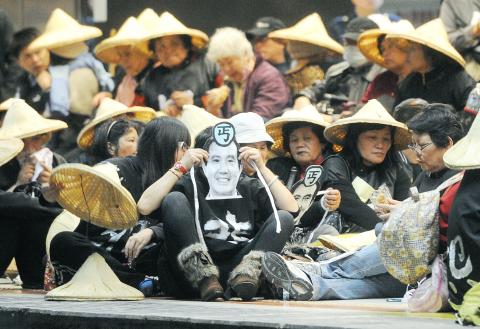
Photo: Wang Min-wei, Taipei Times
“We are not begging for mercy, we will remain in solidarity, nobody’s rights should be undermined,” Taiwan International Workers’ Association secretary-general Chen Hsiu-lien (陳秀蓮) told reporters. “Our only demand is that the council withdraw its lawsuits.”
The protesters held banners asking the council to withdraw the lawsuits, while posting flyers with the words “withdraw lawsuits” on the walls and elevator doors of the building.
The demonstration was continuing as of press time and Pan had yet to show up.
However, the protesters apologized for tying up traffic at Taipei Railway Station on Tuesday night.
“We feel sorry for protesting in such a way, but we had no other choice, because this is the only way they [government officials] could see the suffering of these workers who are in a disadvantaged position,” labor activist Lin Tzu-wen (林子文) said.
Lin, other activists and workers bowed to the public after the apology.
Eight protesters were arrested on Tuesday evening after lying down on one the station’s railway tracks for half an hour. The eight are believed to have been the leaders of the protest.
The Taiwan Railways Administration (TRA) said about 200 people entered the station at 6:50pm after ending a protest at the council. At 7:40pm, they occupied platform three, the agency said, adding that the platform was closed down for safety reasons at 8:10pm.
At 8:25pm, about 40 people jumped onto the railway track and disrupted the operations of the northbound and southbound trains, which did not resume until railway police began making arrests, the TRA said.
The protest delayed 15 trains and about 5,800 passengers.
About 200 police were called in and they carried the protesters away from the station, finally clearing the area at 9:10pm.
The TRA said the protesters would be handled by the railway police, and could face charges of violating the Railway Act (鐵路法) and endangering public safety.
“We respect their right to voice their opinions, but we hope they will choose to do so at legal locations. They should not challenge the public’s power and affect other people’s rights to access the transportation system,” the agency said.
President Ma Ying-jeou (馬英九) said that while the government wanted to help the protesters, the issue must be handled through legal channels.
The government had given money to the workers in the form of loans, and it would require a legal cause for it to absorb the expenditure.
“This is not an issue of resolution. It’s a legal problem. Without laws and regulations to list the money as part of the government’s budget, no civil servant would dare to enter the loans as an item of government expenditure,” he said.
Ma said the council is seeking to help the workers by providing the workers with subsidies.
Meanwhile, the Democratic Progressive Party (DPP) condemned Pan for “his negative comments that ignored these workers’ hard work and suffering.”
“The government is obligated to strive for benefits and solve problems for workers, but it is government malfeasance that has caused the workers’ suffering,” DPP spokesperson Lin Chun-hsien (林俊憲) said.
Pan’s comment that the workers were using their bodies as tools for protest was “out of character,” Lin said.
The council should stop asking the laid-off workers to repay the loans so they could live with dignity and without fear, former DPP chairperson Tsai Ing-wen (蔡英文) said on her Facebook page.
She urged the public to pay attention to the workers’ protest because “if we ignored them now, the same thing could happen repeatedly and we could be the next victims.”
Additional reporting by Mo Yan-chih

‘NO SECURITY RISK’: The Railway Bureau reassured the public that the technicians’ activities were limited to technical guidance and did not involve sensitive systems The Railway Bureau yesterday said it had invited eight Chinese technicians to assist with an airport MRT construction project. The bureau issued the confirmation after an Internet user said Chinese nationals had entered the construction zone of Taiwan Taoyuan International Airport’s Terminal 3 project. They asked why “individuals from an enemy state” were allowed access to such a major national infrastructure project, which raised serious concerns over Taiwan’s industrial safety, sensitive systems and information security. The bureau’s Northern Region Engineering Branch Office said subcontractor Taiwan Handle Industrial Co (台灣手把工業) of the Taoyuan airport MRT’s “Contract No. CU05 Project A14 Station Civil, MEP &

A US uncrewed surface vessel (USV) encountered multiple Chinese warships during an autonomous transit of the Taiwan Strait, US defense company Seasats said in a statement on Wednesday. Seasats announced that a Lightfish USV had completed the first autonomous transit of the Taiwan Strait. Over five days, the USV traversed the entire length of the Strait while constantly monitoring surface vessel traffic, the company said. The Lightfish encountered multiple Chinese warships, one of which was a Chinese People’s Liberation Army Navy (PLAN) Type 056 corvette, it said. The Chinese vessels were operating “well within Taiwan’s exclusive economic zone without transmitting their identity via the

Taiwan is still in the process of assessing the possibility of recruiting workers from Eswatini, the Ministry of Foreign Affairs said yesterday, adding that its goal is to help Eswatini upgrade its vocational training centers. If there are plans to recruit workers from Eswatini, safeguarding national security, protecting public health and ensuring the employment rights of Taiwanese would be prerequisites, Department of West Asian and African Affairs Director-General Yen Chia-liang (顏嘉良) told a news conference. Key considerations would also include filling labor shortages in specific industries, and fostering bilateral professional and technical exchanges, he said. Yen was asked about the progress of labor
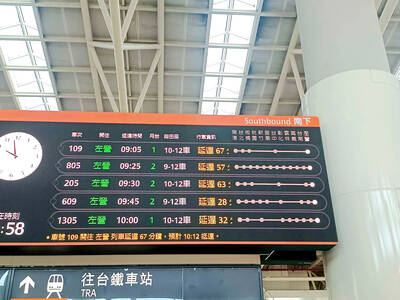
The nation’s usually punctual high-speed rail system yesterday was hit by major disruptions after all scheduled services were canceled and replaced with three hourly trains offering only non-reserved seating, affecting more than 200,000 passengers. Preliminary findings indicate the disruption was caused by a faulty power module in a track switch control cabinet, Taiwan High-Speed Rail Corp (THSRC) said, adding that as a full system inspection could only be conducted after operations end for the day, a decision on whether normal service would resume today would be announced before the first train departs. During a routine inspection early yesterday, a switch signal abnormality


 RSS
RSS